
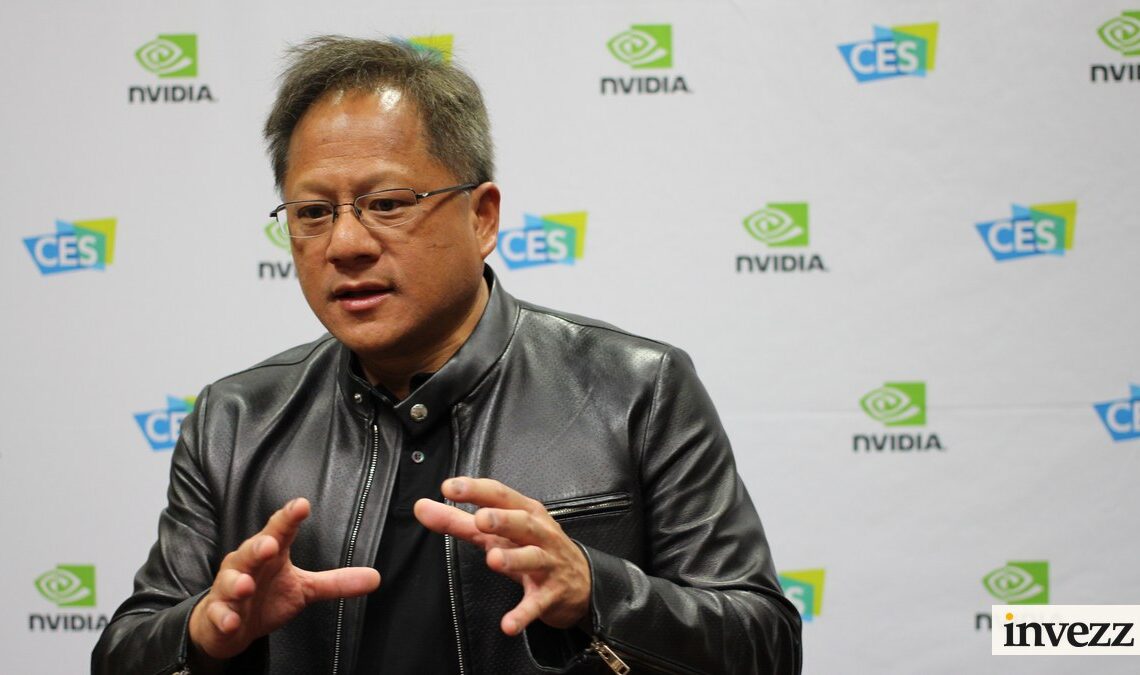
Jensen Huang’s resignation as Nvidia’s chief executive ends a 33-year run in which he turned a graphics start-up, sketched out in a San Jose diner, into the company at the centre of the artificial intelligence boom.
Nvidia shares were at $170.34 in pre-market trading at 10:22 am GMT on Friday, up 2.5% from Thursday’s close of $166.19.
At that close, the company was worth about $4 trillion, based on the 24.1 billion shares listed in its latest quarterly filing.
That is roughly $1.8 trillion less than at its record close of $239.24 on 6 October, Invezz calculations show, a 30.5% fall.
Huang told staff on 8 November that he had been unfaithful to his wife. The board accepted his resignation on 11 November, according to an 8-K filing, and chief financial officer Colette Kress is now interim chief executive, Nvidia said on Thursday. She presents third-quarter results on 17 November.
Our timeline of Huang’s exit covers the past fortnight.
From a Denny’s booth to a chip start-up
Huang was born in Taiwan in 1963 and sent to the US aged nine. He and his older brother were enrolled at the Oneida Baptist Institute in Kentucky before the family settled in Oregon.
As a teenager, he worked at Denny’s, washing dishes and then clearing tables. “I washed the living daylights out of those dishes,” he said in a 2024 Stanford Graduate School of Business interview.
He earned an electrical engineering degree from Oregon State University in 1984, designed microprocessors at AMD and then spent eight years at LSI Logic, while completing a master’s at Stanford, Nvidia’s 1999 IPO prospectus shows.
In April 1993, aged 30, he founded Nvidia with Chris Malachowsky and Curtis Priem, two Sun Microsystems engineers. The plan took shape over meetings at a Denny’s in San Jose.
Near-collapse, then the first GPU
The first product nearly sank the company. The NV1, launched in May 1995, was built around Nvidia’s own approach to 3D just as the industry settled on Microsoft’s Direct3D, and sales slumped, the company’s 1999 annual report says.
Nvidia abandoned a follow-up console chip for Sega and cut more than half of its staff. Sega turned its final payment into a $5 million investment that kept the start-up alive.
The episode gave Huang his best-known phrase. “The phrase ’30 days from going out of business’ I’ve used for 33 years,” he told Joe Rogan in December 2025, according to Business Insider.
The RIVA 128, shipped in August 1997, turned things round. Revenue rose from $29.1 million in 1997 to $158.2 million in the year to January 1999.
Nvidia listed on Nasdaq on 22 January 1999, selling 3.5 million shares at $12 to raise $42 million. They closed the first day at $19.69, valuing the company at $626.1 million, The Wall Street Journal reported at the time.
That August, it launched the GeForce 256, which it marketed as the world’s first GPU. Microsoft chose Nvidia graphics for the original Xbox, and in November 2001 Nvidia replaced Enron in the S&P 500.
The CUDA bet and the deep-learning breakthrough
The decision that would define Huang’s legacy came in 2006, when Nvidia launched CUDA, software that let programmers use its graphics chips for general computing.
The payoff took years. In 2008, Nvidia took a charge for faulty laptop chips as the financial crisis hit, and its split-adjusted shares fell 85% from their October 2007 peak to a November 2008 low, Yahoo Finance data shows.
The turn came in 2012, when AlexNet, an image-recognition network trained on two Nvidia GeForce GTX 580 cards, won the ImageNet contest. Researchers began treating Nvidia GPUs as the default tool for deep learning.
In August 2016, Huang personally delivered Nvidia’s first DGX-1 AI system to OpenAI, then a non-profit research lab.
He then pushed into data centre networking with the $6.9 billion purchase of Mellanox, completed in 2020. A $40 billion deal for Arm collapsed in February 2022 under regulatory opposition, and two crypto-mining booms left gaming sales swinging.
How data centres took over
The shift shows up in Nvidia’s annual reports. In fiscal 2016, which ended in January 2016, data centre sales were $339 million, 7% of $5.0 billion in revenue, while gaming brought in $2.8 billion, the company’s fiscal 2017 10-K shows.
Data centre overtook gaming in fiscal 2023, with $15.0 billion of $27.0 billion in sales. OpenAI had launched ChatGPT in November 2022, and demand for Nvidia’s H100 chips surged.
In May 2023, Nvidia guided quarterly revenue of about $11 billion, well above Wall Street forecasts. The shares jumped 24% the next day, and the company first touched a $1 trillion valuation on 30 May.
Revenue then reached $60.9 billion in fiscal 2024, $130.5 billion in fiscal 2025 and $215.9 billion in fiscal 2026, its latest 10-K shows. Data centre sales were $193.7 billion of that, or almost 90%.
The momentum has continued into fiscal 2027 with the Blackwell and Vera Rubin platforms. Second-quarter revenue hit a record $96.2 billion, and Nvidia has guided $108 billion for the third quarter.
How Nvidia stock has grown since its IPO
Nvidia has split its stock six times: 2-for-1 in June 2000, September 2001 and April 2006, 3-for-2 in September 2007, 4-for-1 in July 2021 and 10-for-1 in June 2024. One IPO share is now 480 shares, so the $12 listing price works out at 2.5 cents.
At Thursday’s close, that is a gain of about 6,650 times, before dividends, or roughly 37% a year, Invezz calculations show. A $1,000 stake at the IPO would now be 40,000 shares worth about $6.6 million.
The climb was far from smooth. The stock lost about 90% between January and October 2002, 56% in late 2018 after a crypto-driven inventory glut and 66% between November 2021 and October 2022.
Most of the value has come since ChatGPT. The shares are up almost 10 times from their close on 30 November 2022, the day it launched.
Nvidia was valued at $2 trillion in February 2024 and $3 trillion in June 2024. It became the first company to reach $4 trillion, in July 2025, and $5 trillion, on 29 October 2025, as Reuters reported at the time.
What Huang leaves behind
Huang built Nvidia around a single long bet, that the chips made for games could run the world’s most demanding computing. That bet is now the business: a data centre franchise tied together by CUDA software, which has given Nvidia a lead that rivals are still trying to close.
He leaves without a named successor. The board has said it will consider internal and external candidates, and Kress keeps the CFO role while she runs the company.
Her first test comes on 17 November. Investors will be looking for the numbers, but also for signs that the company Huang built can keep its customers and engineers without him.
AI disclosure: AI tools assisted with research and drafting of this piece. An Invezz editor reviewed the facts, sources and wording before publication. Any opinions or analysis are Invezz’s, not those of an automated system.
The post Jensen Huang career timeline: from a Denny's booth to the centre of the AI boom appeared first on Invezz