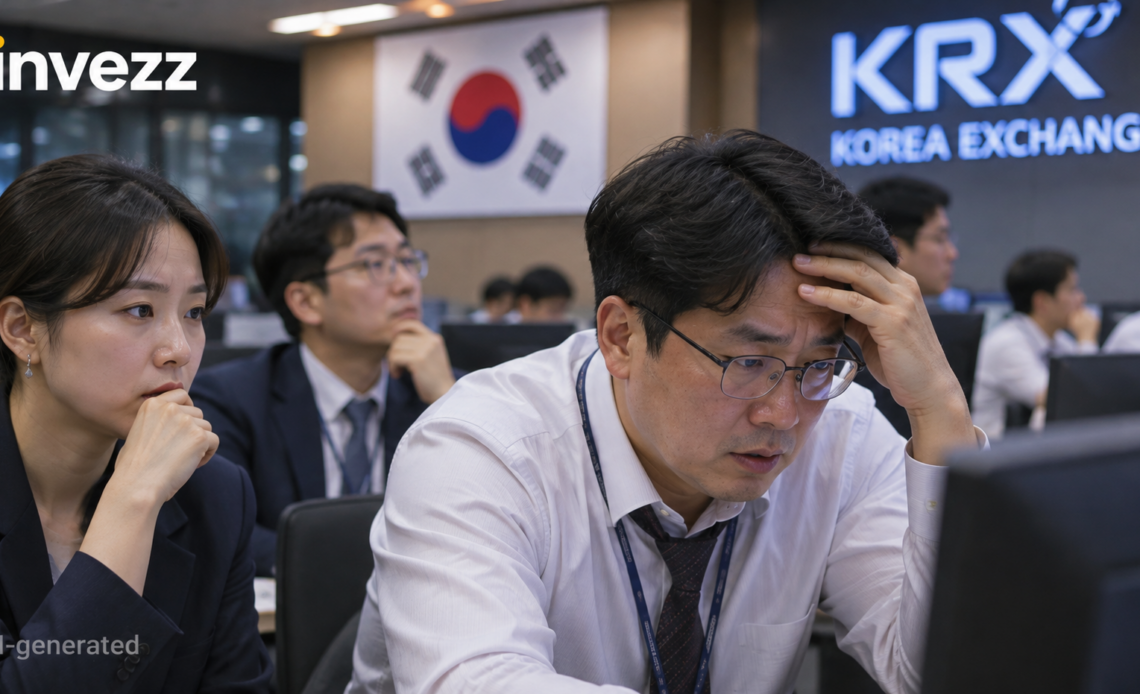
South Korea’s stock exchange halted trading just three minutes after Friday’s opening bell as the KOSPI plunged more than 8%, extending a sell-off driven by fears about the future of artificial intelligence spending.
The benchmark fell to 4,924.61 at 9:03 am in Seoul, triggering a 20-minute circuit breaker after Thursday’s 5.28% drop. Samsung Electronics and SK Hynix briefly suffered double-digit losses.
The KOSPI later recovered above 5,000, reaching 5,144.31 by 11:28 am, although it remained down 4.45%.
The rebound offered limited reassurance after a brutal Wall Street technology rout and heavy foreign selling.
KOSPI crash today: 8% plunge triggers emergency trading curbs
The KOSPI opened 2.24% lower at 5,263.26 before losses accelerated almost immediately.
Within minutes, the index was down 8.52%, prompting the Korea Exchange to activate its first-level circuit breaker.
Under exchange rules, a decline of at least 8% lasting one minute automatically suspends trading in KOSPI shares and related derivatives for 20 minutes. It is a cooling-off mechanism, not a technical breakdown or a permanent market closure.
Trading resumed, but the benchmark remained down 7.84% at 4,961.62 by 9:50 am. Its subsequent recovery illustrated how quickly prices were swinging.
It slows panic trading without guaranteeing that subsequent selling will ease.
The smaller KOSDAQ market also activated a separate sell-side sidecar, temporarily restricting programme sell orders for five minutes. Unlike the main-market circuit breaker, that measure did not halt all trading.
Kiwoom Securities analyst Han Ji-young warned that volatility was likely to persist despite the pause, according to Yonhap on Friday.
The KOSPI 200 volatility index climbed to 64.74, a three-month high, underscoring investors’ unease.
Samsung SK Hynix stock crash
Thursday’s US sell-off left Asian chipmakers exposed. The Nasdaq Composite lost 5.52%, while the Philadelphia Semiconductor Index tumbled about 12.25% as investors questioned the profitability of enormous AI infrastructure projects.
Democratic gains in the November 3 midterm elections added uncertainty over future oversight of American data-centre construction. No sweeping new restrictions had been enacted and concerns about financing and elevated valuations predated the vote.
Samsung and SK Hynix represent nearly half of the KOSPI’s market value. Their shares fell roughly 10% and 13% during the initial rout, magnifying the broader benchmark’s decline.
The sector remains profitable, but investors are reassessing its future growth.
Both companies supply advanced memory used alongside AI processors. Any slowdown in US data-centre investment could eventually affect their order outlook, even if demand remains strong today.
Jun Kwang-woo, chairman of the Institute for Global Economics, told Reuters that the election outcome may have prompted an excessive reaction, although AI construction could slow.
By 11:28 am, Samsung’s decline had moderated to 3.67% and SK Hynix’s to 6.17%.
South Korea stock market crash: Foreign selling remains biggest test
Overseas investors sold a net 302 billion won of KOSPI shares by 9:50 am, against institutional buying of 235.4 billion won and retail purchases of 25.7 billion won.
By 11:28 am, foreign selling had reached 972.1 billion won, while local institutions and individuals were buying. Foreigners had already unloaded about 3.44 trillion won on Thursday.
Such withdrawals matter because international funds hold substantial stakes in Korea’s chipmakers and can move the index sharply when they reduce exposure.
Local bargain hunting can cushion falls without reversing persistent overseas withdrawals.
Daishin Securities analyst Lee Kyung-min argued in a Friday note reported by Yonhap that the AI sell-off was excessive.
Tighter American oversight might delay some data centres, he said, but was unlikely to stop construction entirely.
Authorities pledged to monitor volatility and consider stabilising measures, without promising a market recovery.
The post Why did South Korea halt KOSPI trading after an 8% crash? appeared first on Invezz