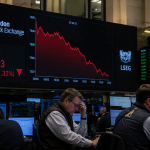

Japan’s Nikkei 225 fell more than 1% on Friday as a fresh sell-off in AI-linked shares collided with $100-plus oil and still-elevated global bond yields, leaving Tokyo at the centre of a broader retreat in risk assets.
The index was down about 1.1% at 68,266.74 in afternoon trade, roughly 3.4% below Tuesday’s close above 70,680.
SoftBank Group dropped more than 6%, while Kioxia Holdings and other semiconductor names also fell.
The move followed another weak session for US technology shares, where the Nasdaq Composite lost 1.25% and the S&P 500 declined 0.47%. The Dow Jones Industrial Average, by contrast, edged 0.1% higher.
AI-heavy Nikkei takes the sharper hit
The Nikkei is particularly exposed when investors cut AI risk.
Technology accounted for about 44.7% of the index by weight on Thursday, while Advantest, Tokyo Electron and SoftBank together represented almost 29%.
That concentration amplified concerns sparked by a Financial Times report that OpenAI’s annualised revenue was running at about $50 billion at the end of September, around $20 billion below a figure previously signalled to investors and the media.
The gap added to questions over whether AI revenue growth can justify the scale of investment now being planned.
Japan’s domestic backdrop offered little support. Government data released Friday showed real household spending fell 3.1% from a year earlier in August.
Elsewhere in Asia, the MSCI Asia Pacific equities gauge slipped about 0.1% and Japan’s broader Topix edged lower. South Korean and Taiwanese markets were closed for holidays.
Oil above $103 keeps rate pressure alive
Brent crude remained near $104 a barrel in Asian trading after jumping more than 4% on Thursday as shipping risks in the Middle East and disruption fears in the Gulf of Mexico tightened the supply outlook.
Donald Trump said the US would not attack Iran before the November 3 midterm elections, but the statement did not remove the geopolitical risk premium from energy markets.
Higher oil prices matter directly for Japan, a major energy importer, while also reinforcing global inflation concerns.
The bond response has been just as important for equities. The US 10-year Treasury yield remained around 5.2% on Friday after touching multi-year highs earlier in the week, although stronger demand at Treasury auctions helped calm the latest sell-off.
Costly capital turns AI spending into a valuation test
The pressure is no longer just about earnings expectations. Investors are also questioning how the next phase of AI infrastructure will be financed.
Broadcom, Oracle and SpaceX are seeking tens of billions of dollars for chips and data-centre expansion, while Nvidia-backed Australian operator Firmus shelved a planned $5 billion IPO, citing volatile market conditions.
Charu Chanana, chief investment strategist at Saxo, argued in a Saxo Bank outlook that higher yields are forcing investors to demand stronger AI economics, better cash generation and healthier balance sheets.
The same funding stress is visible in sovereign debt. French bond spreads remain elevated ahead of the 2027 presidential election.
ING analysts wrote in an ING Think note that political uncertainty could keep the 10-year French-German spread in roughly a 125-to-150 basis-point range.
The post Nikkei falls 1% as SoftBank sinks 6%: is Japan’s AI trade starting to crack? appeared first on Invezz