
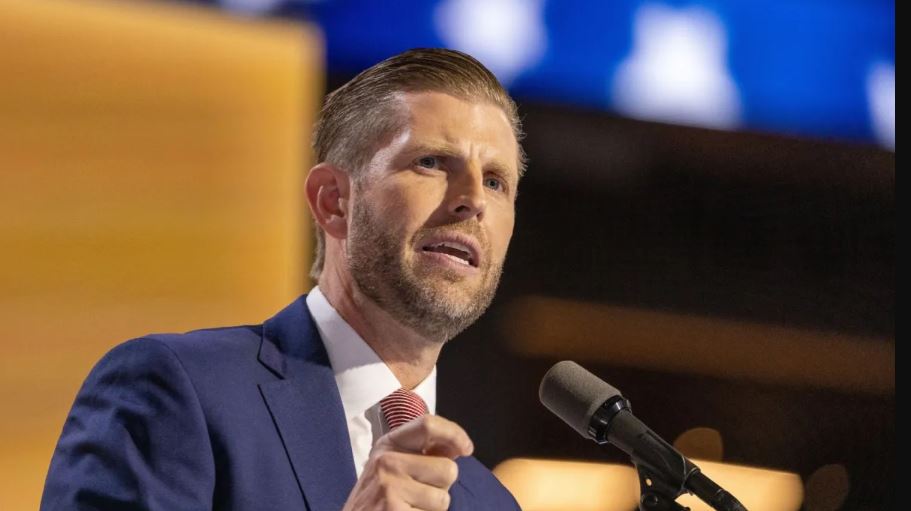
American Bitcoin, the Bitcoin mining and treasury company co-founded by Eric Trump, has plunged more than 95% from its peak, wiping out hundreds of millions of dollars in market value and underscoring the deep pressure facing crypto-linked public companies during the latest market downturn.
The company’s shares have fallen sharply from their September high, forcing American Bitcoin to execute a 1-for-15 reverse stock split to maintain its Nasdaq listing. The move reduced outstanding shares from about 1.09 billion to roughly 73 million, according to market reports, but did little to reverse investor concerns over the company’s falling valuation, operating losses and heavy exposure to Bitcoin.
Eric Trump, who serves as chief strategy officer and owns roughly 6% of the company, has seen the value of his stake fall by more than $600 million over the past 10 months. American Bitcoin is backed by the Trump family and digital infrastructure company Hut 8, which owns a majority stake. Donald Trump Jr. also advises the firm.
The decline comes despite the company continuing to accumulate Bitcoin. American Bitcoin recently added 500 BTC, bringing its total holdings to more than 8,000 BTC. But the strategy has not protected shareholders from a brutal repricing in Bitcoin mining equities, especially as investors favor companies that can repurpose power and data-center infrastructure for artificial intelligence workloads.
Bitcoin Treasury Strategy Comes Under Pressure
American Bitcoin was built around a straightforward thesis: mine Bitcoin efficiently, accumulate coins on the balance sheet and create public-market exposure to Bitcoin through an operating mining business. That strategy worked while investor enthusiasm for Bitcoin treasuries and mining companies remained high. It has become harder to defend as Bitcoin prices weakened and mining economics deteriorated.
The company reported a $117.2 million impairment on its Bitcoin reserves and a $118.2 million operating loss in the first quarter, according to market reports. Those figures highlighted the vulnerability of a company whose public-market value depends heavily on both Bitcoin’s price and investor willingness to pay a premium for corporate Bitcoin exposure.
The market has also shifted against pure-play miners. After the Bitcoin halving reduced block rewards, miners faced tighter margins, higher competition and growing energy costs. At the same time, AI demand has created a new opportunity for firms with access to power, land and data-center infrastructure. Some miners have pivoted toward high-performance computing and AI hosting, attracting investor interest even as crypto mining revenue came under pressure.
American Bitcoin has remained more closely tied to Bitcoin accumulation. Eric Trump has argued that the company differentiates itself through its mining profitability, low overhead and continued coin accumulation. He has publicly encouraged investors to hold through the downturn. The market, however, has treated the company more like a leveraged Bitcoin proxy than a diversified infrastructure business.
Trump-Linked Crypto Bets Face Scrutiny
The collapse adds to scrutiny around Trump family-linked crypto ventures, many of which have experienced steep declines from peak valuations. American Bitcoin is separate from World Liberty Financial and Trump-branded memecoins, but it belongs to the broader category of politically visible crypto businesses that attracted investor attention during the last speculative cycle.
That political association helped American Bitcoin gain visibility, but it also increases reputational risk when losses mount. Critics argue that retail investors can be drawn into politically branded ventures without fully appreciating the volatility of the underlying assets or the difference between insider ownership and ordinary shareholder outcomes.
For investors, the key issue is whether American Bitcoin can survive long enough for a Bitcoin recovery to restore confidence. The company holds a meaningful Bitcoin treasury, but that exposure cuts both ways. If Bitcoin rebounds sharply, American Bitcoin could benefit from balance-sheet appreciation and renewed speculative interest. If Bitcoin remains weak, impairments, liquidity pressure and dilution risk could continue to weigh on the stock.
The broader market impact is limited because American Bitcoin is not large enough to threaten the crypto sector or the public equity market. The symbolic impact is larger. The company’s decline shows that even high-profile Bitcoin treasury and mining strategies can fail to protect shareholders when market conditions turn, especially if investors prefer miners with AI optionality or stronger cash-flow diversification.
American Bitcoin’s 95% collapse is therefore more than a company-specific sell-off. It is a warning about the risks of combining political branding, Bitcoin leverage and public-market speculation. For shareholders, the central question is no longer whether the company can accumulate more Bitcoin, but whether it can build a sustainable operating model around that exposure.