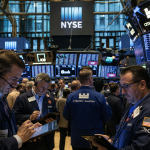
Wall Street staged a powerful recovery on Monday, recovering a substantial portion of last week’s losses as a sharp rebound in technology stocks restored investor confidence.
The S&P 500 jumped 4.73% to 7,237.17, while the Nasdaq Composite surged 6.51%.
However, historical market trends suggest that spectacular one-day rallies do not necessarily signal the end of a prolonged downturn.
The Dow Jones Industrial Average gained nearly 1,448 points as Nvidia’s decision to reinstate Jensen Huang as chief executive helped restore confidence in artificial intelligence stocks.
Yet history offers uncomfortable examples of enormous gains occurring months before markets reached their eventual lows.
Why spectacular rallies can precede further losses
Some of the fiercest buying sessions have unfolded during prolonged bear markets, when heavily sold shares rebound on improving headlines, bargain hunting and the unwinding of bearish positions.
On 13 October 2008, the S&P 500 soared 11.58% to 1,003.35 as policymakers sought to contain the financial crisis. Yet the benchmark subsequently sank to 676.53 on 9 March 2009, a further decline of approximately 32.6% from that rally’s closing level.
The dot-com collapse produced a similar warning. The Nasdaq jumped 14.17% on 3 January 2001 after an unexpected half-point Federal Reserve rate cut, but technology shares continued falling until 2002.
Those episodes do not establish that today’s market faces a comparable economic crisis, but show why the size of a single session’s gain cannot establish a durable bottom.
David Rosenberg, founder of Rosenberg Research, warned in MarketWatch ahead of Monday’s session that investors should view any rebound as “a classic countertrend rally and not the rekindling of the bull market”.
Why latest Wall Street rebound could prove more durable
There is also evidence against assuming that Monday’s recovery will fail.
Yahoo Finance analysed 20 occasions since 1993 when the SPDR S&P 500 ETF opened at least 2% higher on a Monday. It found the fund was higher one year later on 17 occasions, with a median gain around 25%.
That small historical sample does not guarantee a repeat, but it challenges the assumption that unusually strong openings always precede renewed selling.
Moreover, Monday’s rebound spread beyond Nvidia. Approximately 85% of S&P 500 constituents advanced, suggesting investors were not simply bidding up one semiconductor stock.
Morgan Stanley’s Mike Wilson believes last week’s rout went too far relative to corporate earnings prospects.
His team estimates market prices imply a 6% fall in 2027 profits, compared with the bank’s forecast for 14% growth and consensus expectations of 17%, Reuters reported.
If earnings remain resilient, lower valuations could attract investors with longer horizons, even after Monday’s sharp rise.
The Federal Reserve could complicate the recovery
Unlike earlier crises, investors cannot assume that the Fed will respond to falling shares with cheaper borrowing.
New York Fed President John Williams said on Monday that inflation was running around 3.5% on the central bank’s preferred measure, above its 2% target.
Markets anticipate another quarter-point increase in December from the current 3.75%–4.00% rate range.
Higher rates could increase the cost of financing AI infrastructure and put pressure on valuations built around future profits.
The VIX, Wall Street’s fear gauge, fell from 35.89 on Friday to 26.62 on Monday, a meaningful easing of stress but still above levels historically associated with calmer markets.
“The moves may sound impressive, but in reality, take the indices back to where they were a couple of trading sessions ago,” Gavin Friend, senior markets strategist at National Australia Bank, told ABC News.
He also noted increased expectations of further Fed tightening.
Investors will get fresh evidence on Wednesday, when October inflation and revised third-quarter growth figures are scheduled for release.
AI disclosure: AI tools assisted with research and drafting of this piece. An Invezz editor reviewed the facts, sources and wording before publication. Any opinions or analysis are Invezz’s, not those of an automated system.
The post Is Wall Street’s historic rally setting investors up for a painful surprise? appeared first on Invezz