Nvidia NVDA plans to invest $3 billion in Meta Platforms as the Facebook parent ramps up its artificial intelligence infrastructure spending.
Meta said on Tuesday it had increased its planned equity fundraising to $97.5 billion, up from the $95 billion announced a day earlier.
The company is seeking additional capital as it invests heavily in data centres, advanced processors and AI models to compete with rivals including OpenAI and Anthropic.
The Facebook parent has launched public offerings of about $35 billion in common and preferred stock and plans to raise up to another $60 billion through a separate at-the-market programme, which allows it to sell shares gradually at prevailing market prices.
Meta increased the common stock offering announced on Monday from $22.5 billion to $25 billion, with shares priced at $625 each.
The at-the-market programme will be linked to the launch of its new Class C shares, which are expected to debut in the first quarter of next year.
Nvidia, Advanced Micro Devices and Broadcom had expressed interest in purchasing up to $5 billion in shares, according to the announcement.
Both Meta and Nvidia shares were flat in premarket trading on Tuesday.
Nvidia and Meta expand AI infrastructure partnership
The investment announcement accompanied an expanded partnership between Nvidia and Meta covering AI models, computing infrastructure and software optimisation.
The companies plan to expand their work on Meta’s Muse family of models, with a focus on improving training and inference performance as demand for AI agents grows.
Meta will expand its deployment of Nvidia infrastructure, including Vera Rubin systems and Vera CPUs for next-generation AI agents.
The companies will also work on Nvidia Spectrum-X Ethernet networking and BlueField-4 technology.
The partnership will include optimisations across workflows to improve performance and total cost of ownership.
The companies will also consider further collaboration around Nvidia’s OpenShell Reference Architecture, including tools for safer deployment and monitoring agent behaviour.
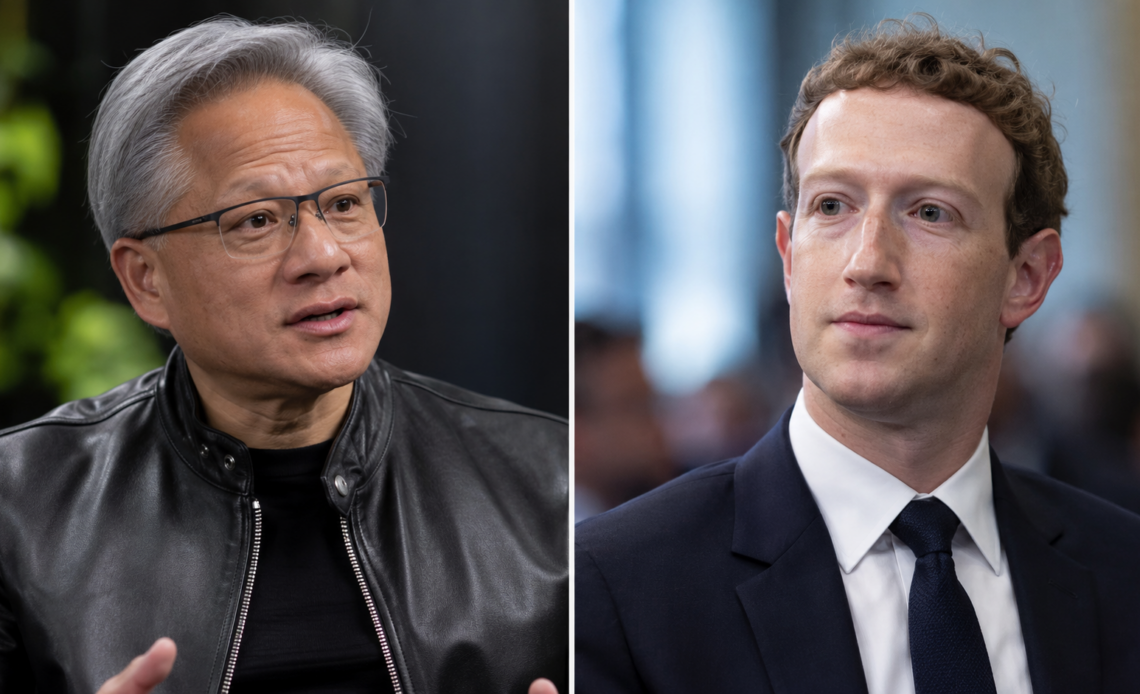
“AI agents represent a new computing paradigm — software that understands our goals, reasons, uses tools and gets work done on our behalf,” said Jensen Huang, founder and CEO of Nvidia.
“This changes how we use computers, from operating applications to working with intelligent agents. NVIDIA and Meta are expanding our partnership to optimize the computing infrastructure end to end for capable, efficient and secure AI agents, so Muse can empower billions of people to achieve more and pursue greater ambitions.”
Meta chief executive Mark Zuckerberg said the collaboration would support the company’s efforts to bring advanced AI capabilities to a broader user base.
“Muse is how we bring personal superintelligence to everyone. We’re excited to keep working with NVIDIA to deliver the best personal agents and frontier models for billions of people,” Zuckerberg said.
Circular financing concerns grow across AI industry
Nvidia’s planned investment in Meta adds to its growing portfolio of stakes in companies driving the AI boom.
The chipmaker has invested in OpenAI, Anthropic, Intel and xAI, among others.
According to Dealroom, Nvidia has participated in 121 investment rounds so far this year, compared with just 13 in 2022.
The growing number of investments has intensified scrutiny of the financial relationships within the AI industry.
Chipmakers are increasingly investing in companies that purchase their processors, potentially helping customers finance the infrastructure that generates revenue for their suppliers.
Meta is spending heavily on chips and data centres as it competes with other AI developers.
Nvidia’s investment could strengthen the relationship between the companies, but it also raises questions about how investors should assess demand when suppliers provide capital to their customers.
“We expect investors to continue to question the financing and potential for future capital raises,” William Blair analysts said in a note.
“Overall, we believe the financing reinforces both Meta’s confidence in the long-term returns from AI investment and the increasingly capital-intensive nature of pursuing that opportunity.”
Ryan Lee, senior vice president of product and strategy at ETF provider Direxion, said it was unsurprising that Nvidia, AMD and Broadcom were interested in supporting Meta’s equity offering.
Semiconductor companies depend on major cloud services providers and other large technology customers continuing to invest in chips and AI infrastructure, he said, as reported by MarketWatch.
However, Lee said the AI industry had reached a point where the capital required to fund the infrastructure buildout was not widely available.
Computing power has constrained AI companies, but financing is increasingly becoming another bottleneck for large technology firms.
There are only a limited number of investors and institutions capable of providing the scale of capital required, Lee noted.
Meta must therefore compete with other AI developers not only for hardware, but also for the funding needed to secure it.
Investors to scrutinise returns and revenue quality
The scale of Meta’s fundraising highlights the financial demands of developing and deploying AI at scale.
While the company is betting that its investments will generate substantial long-term returns, investors will need to assess whether revenue growth can justify the costs.
Devon Coombs, teaching professor of finance at Santa Clara University’s Leavey School of Business, told MarketWatch that investors would need to understand how commercial relationships between companies purchasing products and services from one another affect reported revenue and earnings.
As cash flows become more interconnected, “investors need to understand how much reported revenue represents independent customer demand versus spending supported by investments from companies participating in the same ecosystem,” he said in emailed comments.
Coombs said Meta’s equity offering appeared to be a reasonable way for the company to manage its substantial AI investments.
However, he added that investors should monitor the economics of these interconnected relationships, the sustainability of revenue growth “and whether the industry’s collective investment assumptions are reasonable.”
The post Nvidia to invest $3B in Meta as AI spending drives $97.5B fundraising appeared first on Invezz