
SanDisk is not repricing a broken NAND contract. The shares closed Tuesday, 20 October 2026, at $1,365.38, up $66.08, or 5.09 percent, from the Friday 16 October close of $1,299.30, and the next 50 sessions put a bull at $2,481.99 and a bear at $681.22. The base, which is drift only, is $1,142.59, below the close. That is the number the coverage skips. Luis Visoso’s $93.9 billion figure is a revenue floor at contract prices, not a floor under the share price, and the pair published on 17 October, a bull of $2,532.60 and a bear of $662.86, was calculated off Friday’s close. Two completed sessions later the bull is $50.61 lower and the bear is $18.36 higher, even though the spot is higher, because the mean of the last 90 daily log-returns is negative. The bull is still 81.78 percent above Tuesday’s print because the sample standard deviation of those log-returns is 0.07314. The closes used here are Tuesday’s completed prints. A live quote is not the spot.
Key facts
- Tuesday 20 October 2026 close $1,365.38, down $5.74, or 0.42 percent, from Monday’s $1,371.12. High $1,388.88, low $1,330.00, volume 6,579,861. Nasdaq official daily history, saved 21 October 2026.
- Friday 16 October 2026 close $1,299.30. The move to Tuesday is $66.08, or 5.09 percent. From the 7 October close of $1,692.42 the stock is down $327.04, or 19.32 percent. Same Nasdaq file.
- The 20-day simple average is $1,604.51 and the 50-day simple average is $1,598.78, both calculated from that file. Tuesday’s close is $239.13, or 14.90 percent, under the 20-day line and $233.40, or 14.60 percent, under the 50-day line. The two averages are $5.73 apart.
- Fiscal first-quarter 2027 guidance is revenue of $10.30 billion to $10.80 billion and non-GAAP diluted earnings of $44.00 to $46.00, on about 155 million diluted shares. Sandisk Exhibit 99.1, 5 August 2026.
- Fiscal fourth-quarter revenue was $8.965 billion, up 51 percent sequentially, with GAAP gross margin 84.6 percent and non-GAAP diluted earnings of $39.25. About two-thirds of that sequential revenue gain came from price and about one-third from volume. Same exhibit.
- Fiscal 2026 revenue was $20.248 billion, up 175 percent, and products sold rose by a mid-teens percent on an exabyte basis. Datacenter bits rose almost 120 percent and revenue per gigabyte almost 150 percent. Form 10-K for the year ended 3 July 2026.
- “The total expected revenue from all our NBMs we have signed is a minimum of $93.9 billion, assuming floor pricing,” Luis Visoso, chief financial officer, said on the 5 August call, as reported by The Motley Fool on 14 August 2026. Those agreements cover about half of expected bits in fiscal 2027.
- Mizuho’s target of $2,050, raised from $1,875 with an Outperform rating, is a street number, not the bull above. TipRanks on X, 6 October 2026. On 19 October an account restated a $2,050 target and said NAND pricing stays tight through 2027. @outerninth.
What just happened, and why the obvious reading is wrong
The obvious reading is that the scare ended on Friday. Monday closed at $1,371.12, up 5.53 percent from $1,299.30, and Tuesday gave back $5.74. A bounce after a 19.32 percent drop from 7 October looks like a bid under the NAND price. The 5 August exhibit and the Form 10-K do not say contract prices broke between Friday and Tuesday, and no newer guide was in the documents opened here.
What changed is the distribution. Friday’s published pair was $2,532.60 and $662.86 off $1,299.30. Tuesday’s higher spot, the same style of 90-day window, and a horizon two sessions shorter put the bull $50.61 lower and the bear $18.36 higher. The base is 16.32 percent under the close because the mean log-return is negative.
The price work is still the July quarter. Exhibit 99.1 says sequential revenue growth was about one-third volume and two-thirds price, while the 10-K says products sold rose only by a mid-teens percent on an exabyte basis as revenue rose 175 percent. Datacenter bits rose almost 120 percent and revenue per gigabyte almost 150 percent. The stock can fall 19 percent from 7 October without those sentences being withdrawn. Tuesday also sat inside its own range. The five sessions from 14 October through 20 October closed between $1,299.30 and $1,403.34, and traded between $1,276.00 and $1,461.80. Tuesday’s $1,365.38 is inside both bands and $37.96 under the closing high. It is not inside the moving averages.
Who is exposed
The balance sheet in Exhibit 99.1, as of 3 July 2026, is an equity story. Cash was $4.762 billion. Long-term debt was zero, against $1.829 billion a year earlier. Outstanding common stock was 149 million shares, and treasury stock was $4.537 billion after $4.524 billion of repurchases. An additional $14 billion buyback took the remaining authorization to $15.5 billion. Holders of those shares, and of what is left of that authorization, are the people exposed over the next 50 sessions.
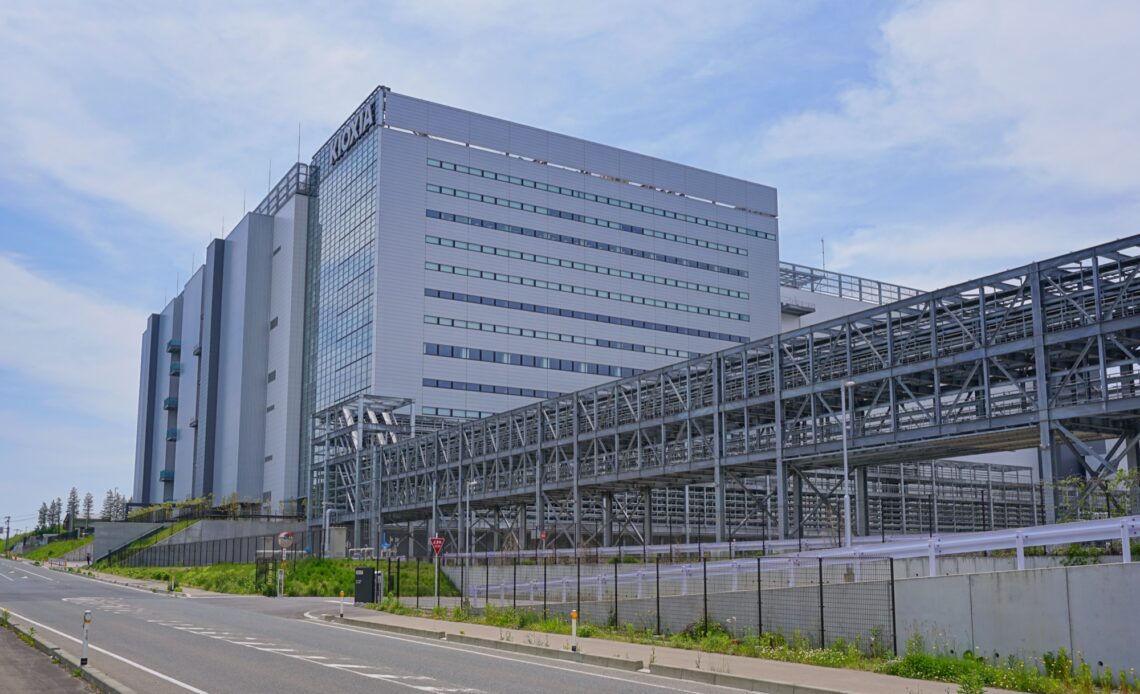
Customers are exposed through deposits, and the eight names stay off the page. Refund liabilities were $1.500 billion. Contract liabilities were $1.242 billion, $849 million current and $393 million non-current, which the 10-K ties to remaining performance obligations and refundable deposits. Adjusted free cash flow was $5.035 billion after removing $1.938 billion of NBM prepayments, against operating cash flow of $7.126 billion. Those deposits are not a bid at $1,365.38. The Motley Fool’s 14 August account puts bit coverage near half of fiscal 2027 and two-thirds of fiscal 2028, with guarantees and deposits of $16.5 billion. Kioxia owns the facilities. SanDisk holds 49.9 percent of each Flash Ventures entity, and that investment was $678 million. The separation from Western Digital closed on 21 February 2025. Seagate and Western Digital are the other storage prints, not the Flash Ventures obligors.
What the tape shows
The highest close in the saved Nasdaq file is $2,335.00 on 25 June 2026. The highest trade is $2,354.39 on 22 June, a day that closed at $2,273.73. Tuesday’s close is 41.53 percent under the June close and 42.01 percent under that June high. From the 21 October 2025 close of $149.29, the stock is up 814.57 percent and still more than 40 percent under the June peak. The 20-day average is $1,604.51 and the 50-day is $1,598.78, only $5.73 apart. Tuesday is 14.90 percent under the shorter line and 14.60 percent under the longer one. The five-session closing range of $1,299.30 to $1,403.34 sits entirely under both.
GAAP diluted earnings were $43.97 and non-GAAP diluted earnings were $39.25. GAAP gross margin was 84.6 percent, against 78.4 percent in the prior quarter and 26.2 percent a year earlier. Edge, at $5.432 billion, was still 60.59 percent of the quarter. The end-market dollars are in the table.
| End market | Q4 fiscal 2026 | Q3 fiscal 2026 | Sequential | Q4 fiscal 2025 |
|---|---|---|---|---|
| Datacenter | $2.977 billion | $1.467 billion | up 103 percent | $213 million |
| Edge | $5.432 billion | $3.663 billion | up 48 percent | $1.103 billion |
| Consumer | $556 million | $820 million | down 32 percent | $585 million |
| Total | $8.965 billion | $5.950 billion | up 51 percent | $1.901 billion |
Source: Exhibit 99.1, 5 August 2026. Full-year datacenter revenue was $5.153 billion, edge $12.160 billion, and consumer $2.935 billion. The guide for the quarter being reported on 29 October, the date The Motley Fool flagged on 12 October, is $10.30 billion to $10.80 billion. The midpoint, $10.55 billion, is 17.68 percent above $8.965 billion. The non-GAAP earnings midpoint of $45.00 is 14.65 percent above $39.25. Tuesday’s $1,365.38 is 7.59 times four quarters of that $45.00 midpoint and 19.26 times fiscal 2026 non-GAAP earnings of $70.88. Those multiples are not the bull or the bear.
What SanDisk has said, and what it has not
David Goeckeler, chairman and chief executive, is quoted in the 5 August exhibit: “We closed fiscal 2026 with a leading technology portfolio, established datacenter as a key growth pillar, and deepened our customer partnerships.” The next sentence is the one the multiple leans on: “Our technology and products are well positioned to create value for our customers and generate growing and durable free cash flow.” That sits next to $7.126 billion of quarterly operating cash flow. It is not a floor under $1,365.38.
Visoso’s floor sentence is narrower than the headline it gets. As reported by The Motley Fool on 14 August, he said on the 5 August call: “The total expected revenue from all our NBMs we have signed is a minimum of $93.9 billion, assuming floor pricing.” The same account puts the guarantees at $16.5 billion. On 12 October the same publication reported that Visoso had described the sequential gain into the September quarter as more storage shipped and “modest price increases,” with non-GAAP gross margin still guided at 83 percent to 85 percent. Modest price increases are not the two-thirds-from-price mix of the June quarter.
The investor-day release itself did not open. The Motley Fool’s 14 August piece says the fiscal 2028 to 2030 framework targets adjusted free cash flow near 50 percent of revenue and non-GAAP gross margins near 80 percent. FinanceFeeds wrote up the setup before that event. This piece does not reuse that page’s scenarios. Goeckeler, as reported there, said supply grows “primarily through nodal transitions rather than wafer additions,” with bit growth in the mid-to-high teens. The company has not named the eight customers, issued a December-quarter guide, or revised the $10.30 billion to $10.80 billion range. The 10-K says the new model reduces cyclicality. It does not say cyclicality has been repealed.
The supply tension that is actually on the page
A 21 October post about Samsung converting Xi’an NAND layers was left out, because the wire copy was not fetched. On 5 October, @jukan05 posted a TrendForce note that enterprise SSDs were expected to remain undersupplied through 2026. The post is the source of that sentence. It matches the quarter: datacenter revenue doubled sequentially and consumer revenue fell. On 19 October, @outerninth wrote that NAND pricing was to remain tight through 2027, with Mizuho’s $2,050 target reiterated. That is a position, not a filing.
The other speed is the contract-price forecast The Motley Fool cited on 12 October. TrendForce, that piece said, expected NAND flash contract prices to climb another 15 percent to 20 percent in the October-to-December quarter, most of SanDisk’s fiscal second quarter, not the quarter reported on 29 October. The same piece says the rest of the output still sells at market prices, and that no downturn has tested the floors. Company-wide exabytes rose by a mid-teens percent in fiscal 2026, so a two-thirds-from-price quarter is the exception the multiple is paying for. The semiconductor-index tape is a separate argument and its level is not imported here.
Bull, base, and bear
The title numbers are not Mizuho’s $2,050 and not the 17 October pair. Log-return is the natural log of close today divided by close yesterday. The window is the last 90 returns, from the 11 June 2026 close through the 20 October 2026 close. The mean, mu, is -0.00356269. The sample standard deviation, sigma, divides by n minus 1 and is 0.07313961. N is 50.
October still has 21, 22, 23, 26, 27, 28, 29 and 30, which is eight. November weekdays run through the 30th with Thanksgiving, 26 November, out and 27 November in, which is 20. December weekdays run through the 31st with Christmas, 25 December, out and 24 December in, which is 22. Eight plus 20 plus 22 is 50. The last session is Thursday 31 December 2026. Early closes count. Full closures do not.
The square root of 50 is 7.07106781. Fifty times mu is -0.17813437. Sigma times that square root is 0.51717511, and 1.5 times that is 0.77576266. Base is $1,365.38 times e to the power of -0.17813437, which is $1,142.59. Bull adds the 0.77576266 term and is $2,481.99. Bear subtracts 0.51717511 and is $681.22. Bull is above the spot, so the no-drift override is not used. The largest absolute log-return in the 90 is 30 July 2026, from $1,015.89 to $1,279.96, up 26.0 percent, a log-return of 0.23106 and about 11.6 percent of the sum of squared deviations. It does not dominate sigma and was not dropped. The next is 25 June, from $1,914.46 to $2,335.00. The mean stays negative with the July gain inside the sample, which is why the base sits under the close.
| Case | Price | Versus $1,365.38 | What has to be true |
|---|---|---|---|
| Bull | $2,481.99 | up 81.78 percent | Drift plus 1.5 standard deviations over 50 sessions. The September guide holds, December contract prices still rise, and the multiple goes $146.99 past the 25 June close of $2,335.00. |
| Base | $1,142.59 | down 16.32 percent | The last 90 sessions’ mean log-return continues and nothing else. The $10.30 billion to $10.80 billion range can still be met. The $93.9 billion book does not have to break. |
| Bear | $681.22 | down 50.11 percent | The same drift minus one standard deviation. The uncontracted half of bits gives back part of the two-thirds-from-price quarter, and the multiple on $70.88 of trailing non-GAAP earnings compresses. |
Mizuho’s $2,050 is 50.14 percent above Tuesday’s close and sits between the base and the bull. The title bull is $431.99 above that target. Rounded, $2,481.99 and $681.22 are not within a dollar of any SanDisk bull-and-bear pair already used in an English FinanceFeeds title.
What happens next
On 29 October 2026 the company is due to report the quarter the guide describes, the date The Motley Fool set out on 12 October. If revenue lands inside $10.30 billion to $10.80 billion, non-GAAP gross margin lands inside 83 percent to 85 percent, and management does not withdraw the “modest price increases” language, the bear case is not a miss on this print. The bear remains the one-standard-deviation path after the print. If the company cuts the range or says price subtracted from sequential growth, the negative mu becomes the operating statement rather than a description of the last 90 sessions.
Through Thursday 31 December 2026, the 50th session, the base path is $1,142.59 if that mean persists. The bull at $2,481.99 is that volatility plus a run of positive log-returns, not a promise that the 25 June close of $2,335.00 gets retaken. A live print does not replace Tuesday’s official close in the formula. The third date is the shelf life of Mizuho’s $2,050, raised on 6 October and restated on 19 October. It stays a comparison only while the 29 October call still points at non-GAAP gross margin near 80 percent. A guide back toward the fiscal 2026 GAAP gross margin of 71.5 percent would leave $2,050 and $2,481.99 as two different arguments, and only the second is in the title.
Frequently asked questions
Where do the next 50 sessions put a SanDisk bull and a bear that are not last week’s pair?
The bull is $2,481.99 and the bear is $681.22, with a base of $1,142.59, off Tuesday’s $1,365.38 close. Last week’s published pair was $2,532.60 and $662.86, off Friday’s $1,299.30. The new bull is $50.61 lower and the new bear is $18.36 higher because the spot, the 90-day window, and the session count all changed. The base is under the close because the mean log-return is negative. These are distribution levels, not a street target.
Does a base under the close mean the NAND guide is about to be cut?
No. The base is $1,365.38 times e to the power of 50 times mu, and mu is -0.00356269. It does not require the $10.30 billion to $10.80 billion range to be missed. The guide can be delivered and the share price can still follow a negative drift. A cut would be extra information. It is not an input to the formula, and the 5 August exhibit has not made one.
What is the $93.9 billion figure, and does it protect the share price?
It is the minimum revenue Luis Visoso said the signed agreements carry, assuming floor prices, as reported by The Motley Fool on 14 August from the 5 August call. The same account puts guarantees at $16.5 billion and bit coverage at about half of fiscal 2027. That is a revenue commitment from unnamed customers. It is not a collar on SNDK. The bear at $681.22 can sit next to an intact contract book.
How is this bull different from Mizuho’s $2,050 target?
Mizuho’s $2,050, raised from $1,875 with an Outperform rating in the TipRanks post of 6 October, is an analyst target. The bull of $2,481.99 is Tuesday’s close times e to the power of the drifted 1.5-sigma term over 50 sessions. The street number is 50.14 percent above the close and sits between the base and the bull. A 19 October post restated $2,050 with a view that NAND pricing stays tight through 2027.
What would make the bear the path that matters on 29 October?
A revenue print inside $10.30 billion to $10.80 billion, with gross margin inside 83 percent to 85 percent, does not by itself select the bear. The bear is selected if management says price is subtracting from sequential growth, or cuts the range. The Motley Fool on 12 October already distinguished modest price increases from falling prices. The call has to cross that line for the negative drift to become the operating statement.
Where does Tuesday’s close sit against the averages and the recent range?
Tuesday’s $1,365.38 is $239.13 under the 20-day average of $1,604.51 and $233.40 under the 50-day average of $1,598.78. The two averages are only $5.73 apart. Against the prior five sessions, the close is inside the closing range of $1,299.30 to $1,403.34 and inside the intraday range of $1,276.00 to $1,461.80. The bounce from Friday recovered part of the range. It did not recover either average.
This is not financial advice.