A quantum computer was sold this week, and almost nothing about that sentence is a revenue event. IonQ announced on 22 September that Florida International University has contracted to take a Superion 256 — the first sale and deployment of the 256-qubit trapped-ion platform in Florida — with installation “currently expected in late 2027, following completion of FIU’s on-campus data center.” No price was disclosed by either party. IonQ closed at $44.98 on 24 September, inside a 52-week range of $25.89 to $84.64, carrying a market capitalisation of $17.09bn against roughly $246m of trailing-twelve-month revenue. That is about 69 times sales for a business whose delivery model looks nothing like the software businesses that usually earn that multiple.
The mismatch is the story. The market is valuing IonQ the way it values a platform company, and IonQ is executing the way a defence prime executes: long-lead, on-premises, milestone-gated, customer-site-dependent, and adjacent to federal funding cycles. The FIU contract makes that explicit in a way no previous announcement has, because the delivery date is governed not by IonQ’s manufacturing but by whether a university finishes a building. Having modelled a few capital-equipment order books through their first delivery cycle, that dependency is where the surprises live — and it is invisible in a bookings headline.
The insight: bookings and revenue are fifteen months apart, and the gap is funded by the balance sheet
The arithmetic is straightforward and nobody is running it. In the second quarter of 2026, IonQ recognised $80.05m of revenue and spent $160.63m on research and development — two dollars of R&D for every dollar of revenue. Revenue is growing very fast (up 287% year on year from $20.69m, with first-half revenue of $144.72m against $28.26m), but the company is not remotely funded by it. What funds the gap between a contract signed in 2026 and a system accepted in late 2027 is the $1.236bn of cash and equivalents on the balance sheet at 30 June.
Investors are broadly comfortable with that structure in software, where the gap between a signed contract and delivered service is measured in weeks. It behaves very differently in capital equipment. This is the same distinction FinanceFeeds drew when Oracle disclosed a $664bn remaining performance obligation and told the market it expects roughly half of it to convert inside 36 months: a backlog is only as good as the conversion schedule attached to it, and the schedule is where the risk sits. It is also the trap behind Palantir’s recent move to a 2026 high on a contract it had actually lost — contract headlines and contract economics are separate instruments.
Key facts: the FIU Superion 256 contract
- IonQ announced a contract with Florida International University for a Superion 256 on 22 September 2026 — the first sale and deployment of the platform in Florida — IonQ, 22 Sep 2026
- Installation is expected in late 2027, after FIU completes its on-campus data centre; the system will sit in a purpose-built secure facility — IonQ, 22 Sep 2026
- No contract value was disclosed by IonQ or FIU. A $25m figure circulated on X following the Quantum World Congress; FinanceFeeds could not verify it against either party’s disclosures and does not treat it as established
- The sixth-generation system carries 256 physical trapped-ion qubits and will be available to FIU’s 55,000 students and more than 1,800 faculty — IonQ, 22 Sep 2026
- Superion 256 launched 8 September 2026; orders opened immediately with customer deliveries in 2027, and IonQ had pre-sold its first system in Q1 2026 — IonQ, 8 Sep 2026
- Q2 2026 revenue $80.05m (up 287% year on year); first-half revenue $144.72m; FY2025 revenue $130.02m — IonQ SEC filings via XBRL company facts
- Q2 2026 research and development expense $160.63m, roughly 2.0x quarterly revenue; cash and equivalents $1.236bn at 30 June 2026 — IonQ SEC filings
- IONQ closed at $44.98 on 24 September; market capitalisation $17.09bn; 52-week range $25.89–$84.64 — Nasdaq, 24 Sep 2026
What IonQ has actually built, and why the manufacturing claim is the important one
Set the contract aside for a moment, because the September product launch contains the more consequential disclosure. IonQ fabricated its first fully integrated 256-qubit processing units at SkyWater, its own subsidiary foundry, after six tapeouts in the first half of 2026. It says the design cycle compressed from nine months to two, and that the teams delivered twelve times more wafer lots over a six-month period than at a previous foundry.
Those are semiconductor metrics, not physics metrics, and that is deliberate. “Superion is the result of two strategic acquisitions coming together to deliver this historic milestone. Oxford Ionics enabled IonQ to control natural, trapped-ion qubits using standard electronics, and SkyWater unlocked the ability to manufacture at semiconductor costs and scale,” said Niccolo de Masi, Chairman and CEO of IonQ. “Superion 256 is the first quantum computer platform designed to be built by the hundreds rather than one at a time.”
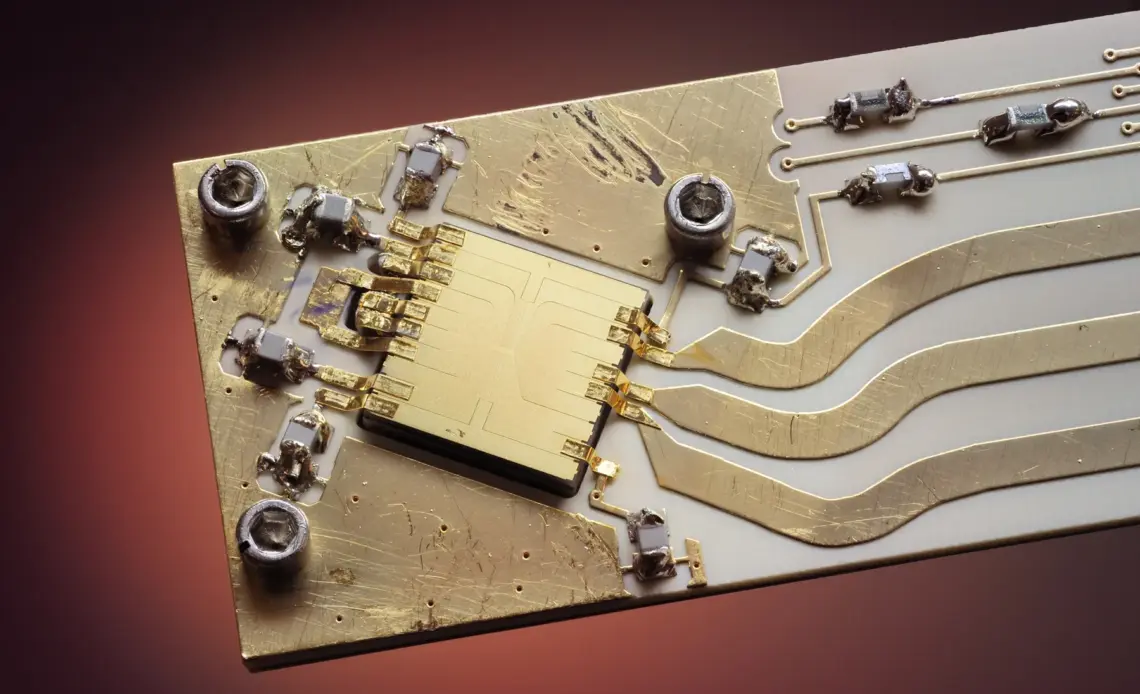
The technical substitution underneath that claim is real: IonQ’s Electronic Qubit Control replaces laser systems with electronics integrated on the chip, manufactured with standard semiconductor processes — the same control technology behind its 99.99% two-qubit gate fidelity record set in October 2025. The practical consequence is that a Superion occupies a standard server rack footprint, needs no bespoke building, draws less power than a rack of GPUs, and cools into a normal data-centre environment. IonQ expects the shift from laser-based to semiconductor-based control to cut cost per qubit by more than 300 times across the roadmap.
If that holds, quantum stops being a laboratory installation and becomes a procurement line. Which makes it all the stranger that a university installation still depends on the university building a data centre first.
Market impact: what the FIU deal does and does not tell you
What it tells you is that the commercial pipeline is real and is broadening beyond national laboratories and cloud partners into the university-and-regional-development channel, which in the United States is heavily federally subsidised. FIU’s own framing was explicit about that: the university runs a research showcase and briefing centre in Washington, D.C., and President Jeanette M. Nuñez said the partnership “puts the university in a leading position to engage with key federal agencies to advance recently launched quantum initiatives that address many national needs in the areas of sensing, cryptography, commercialization and workforce development.” Translated: the machine is a platform for winning federal grants. That is a durable demand channel, and it is also a politically contingent one.
What it does not tell you is price, margin, payment schedule, or acceptance criteria — the four things that determine whether this contract is worth anything to shareholders. With no disclosed value and a delivery date fifteen months out, the announcement is a marketing asset with a revenue tail attached, and the tail lands in a fiscal period most models do not yet contain.
| Dimension | Bull reading | Bear reading |
|---|---|---|
| The contract | First Florida deployment, flagship academic partner, federal-agency adjacency | No price, no payment terms, delivery gated by a building IonQ does not control |
| Revenue trajectory | Q2 revenue up 287% to $80.05m; first half $144.72m versus $28.26m | $246m trailing revenue against a $17.09bn market cap is roughly 69x sales |
| Manufacturing | In-house SkyWater foundry, six tapeouts in H1, design cycle cut from nine months to two | Zero Superion systems have been installed and accepted anywhere |
| Balance sheet | $1.236bn cash funds the order-to-delivery gap without dilution pressure | R&D alone ran $160.63m in one quarter, twice revenue; GAAP results swing violently on fair-value items |
That last point deserves a flag for anyone reading headline earnings. IonQ’s GAAP net result swung from a reported profit of $805.36m in the first quarter of 2026 to a loss of $1.868bn in the second, producing a first-half net loss of $1.062bn. Swings of that magnitude on a company with $145m of half-year revenue are not operating outcomes; they are fair-value remeasurements. Anyone underwriting this equity should be modelling cash burn and backlog conversion, not net income.
The regulatory and strategic tension
Quantum sits in an unusual position: it is simultaneously a subsidised national priority and a controlled technology. The same federal interest that makes a university deployment commercially attractive also brings export licensing, security-clearance requirements for facilities, and end-use restrictions that do not apply to conventional high-performance computing. FIU’s system will be housed in a “specialized, secure facility,” which is a procurement requirement as much as an engineering one.
Running alongside that is the cryptographic clock. European supervisors have already warned that quantum computing could threaten the cryptography underpinning Bitcoin, and the same logic applies to every settlement system, custody arrangement and messaging network in wholesale finance. That creates a strange dual demand: institutions buy quantum capability partly to understand the threat that quantum capability creates. It is a durable source of budget, and it is one of the few commercial rationales in this sector that does not depend on a fault-tolerant machine arriving on schedule.
On schedule is the operative phrase. Chris Ballance, President of Quantum Computing at IonQ, was specific about the roadmap: “CMOS integration is expected to reach full fault tolerance reality in a 2027 lab setting at IonQ, and manufacturable, commercial reality in 2028.” Every valuation argument for this company routes through that sentence.
Three things to watch
One: the first installed and accepted Superion, not the next order. IonQ pre-sold a Superion 256 in the first quarter of 2026 and has now announced a second named customer, with deliveries beginning in 2027. Orders are cheap to announce and expensive to fulfil. The disclosure that will move the multiple is an acceptance — a system installed, commissioned and signed off at a customer site — because that is the event that proves the manufacturing claim and converts backlog into recognised revenue.
Two: the first hard price will come from a procurement record, not from IonQ. Vendors do not publish list prices while they are establishing average selling prices in a market with two or three credible suppliers. Public universities and federal agencies, however, generate paper. Expect the first verifiable Superion price to surface in a board agenda, a state purchasing filing or a grant award document — and expect it to reframe the sector’s revenue models more than any earnings call will.
Three: 2028 is the number that matters, and slippage compresses the multiple faster than wins expand it. At roughly 69 times trailing sales, IonQ is priced for the fault-tolerant roadmap, not for the current order book. A single additional university contract adds very little to that; a six-month slip in the CMOS fault-tolerance milestone subtracts a great deal. The asymmetry is unfriendly, which is why the stock sits 47% below its 52-week high despite a year of genuinely strong commercial news. Our bull and bear case on IONQ and the comparable analysis on Rigetti set out how wide that distribution currently is.
None of this makes the FIU contract unimportant. Andres G. Gil, FIU’s senior vice president for research and economic development, described a machine that will “enable our team to run complex computational workflows” and train “the skilled workforce needed to support Florida’s growing quantum industry.” Workforce and regional development are how expensive technologies acquire political constituencies, and political constituencies are how they acquire budgets. It is a genuinely good deal for IonQ. It is simply not, yet, a number.
FAQ
What did IonQ sell to Florida International University?
A Superion 256, IonQ’s sixth-generation quantum computing platform with 256 physical trapped-ion qubits. It is the first sale and deployment of a Superion 256 in Florida. The system will be housed in a purpose-built secure facility on FIU’s campus and made available to the university’s 55,000 students and more than 1,800 faculty, with research spanning materials science, AI, logistics, cybersecurity, health and power grid management.
When will the IonQ system be installed?
Installation is currently expected in late 2027, following completion of FIU’s on-campus data centre. The timeline therefore depends on the university’s construction schedule as well as IonQ’s manufacturing, which is an unusual dependency for a contract being read as a commercial milestone.
How much does a Superion 256 cost?
Neither IonQ nor FIU disclosed a contract value. A $25m figure circulated on X after the Quantum World Congress, but FinanceFeeds could not verify it against either party’s public disclosures and does not treat it as established. The most likely source of a verifiable price is a public procurement or grant record rather than a company announcement.
What is IonQ’s revenue and valuation?
IonQ reported $80.05m of revenue in the second quarter of 2026, up 287% year on year, and $144.72m in the first half against $28.26m a year earlier. Trailing-twelve-month revenue is roughly $246m. At a $44.98 close on 24 September and a $17.09bn market capitalisation, that is about 69 times trailing sales.
Why did IonQ report a $1.87bn quarterly loss?
Because GAAP results at this company are dominated by fair-value remeasurements rather than operations. IonQ reported net income of $805.36m in the first quarter of 2026 and a net loss of $1.868bn in the second, for a first-half net loss of $1.062bn — swings far larger than the $144.72m of half-year revenue. Cash burn and backlog conversion are the meaningful metrics; net income is not.
When does IonQ expect fault-tolerant quantum computing?
Chris Ballance, IonQ’s President of Quantum Computing, said CMOS integration is expected to reach “full fault tolerance reality in a 2027 lab setting at IonQ, and manufacturable, commercial reality in 2028.” IonQ also expects the move from laser-based to semiconductor-based qubit control to reduce cost per qubit by more than 300 times across its roadmap.