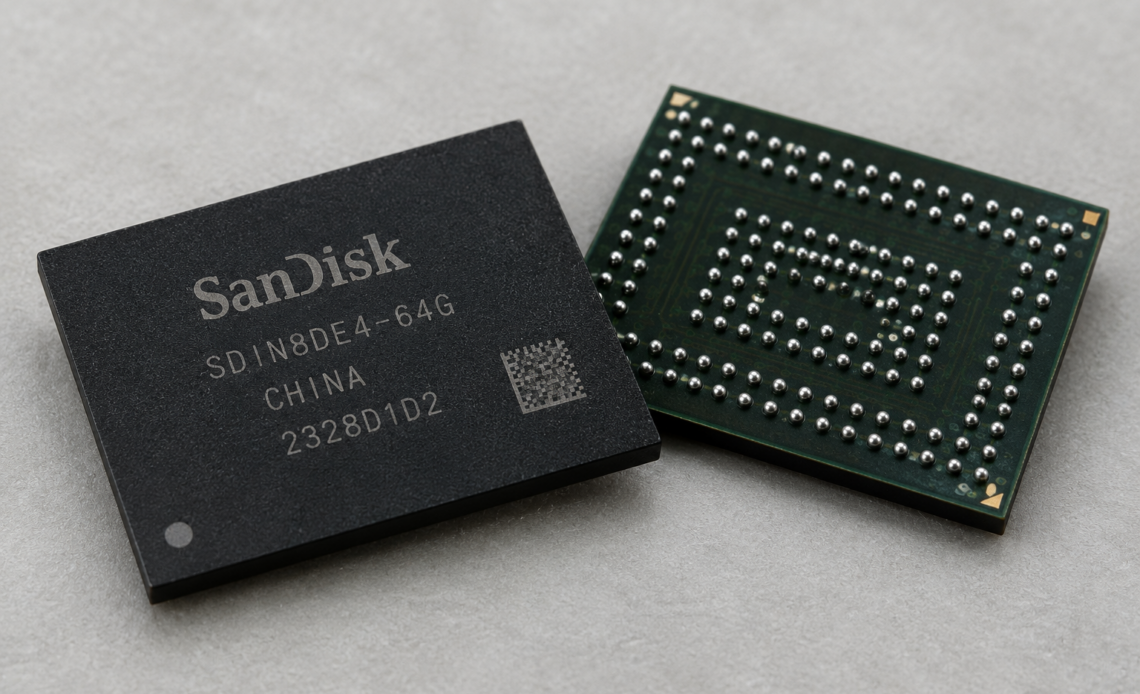
SanDisk stock (NASDAQ: SNDK) extended its decline after Thursday’s earnings announcement, despite the memory maker reporting a 378% jump in quarterly revenue and stronger profits than Wall Street expected.
The stock fell another 3.8% in late trading after sliding 5.3% during the regular session to $1,330.05.
Fiscal first-quarter revenue reached $11.03 billion, while adjusted earnings climbed to $49.51 a share, both ahead of forecasts.
Data-centre sales surged as artificial intelligence customers bought more storage. But weakness in consumer products and doubts about how long elevated memory prices can last have left investors reluctant to reward another record-breaking quarter.
Why earnings beat failed to lift SanDisk stock
SanDisk’s revenue climbed from $2.31 billion a year earlier, easily topping estimates near $10.7 billion. Adjusted earnings exceeded expectations of roughly $46.67 a share, while its non-GAAP gross margin widened to 85.1% from 29.9%.
The strength was striking, but not universal, leaving important questions about growth elsewhere.
Consumer revenue fell 39% from a year earlier to $397 million, and declined 29% from the previous quarter. Edge revenue increased 7% sequentially to $5.83 billion but disappointed some analysts.
Those weaker areas matter because they reveal how much the company’s earnings depend on exceptional pricing and demand from data-centre customers.
“The market is telling you that expectations are changing for how long the earnings boom is going to last for these companies,” Equity Armor Investments portfolio manager Joe Tigay told Bloomberg in comments published October 27, before SanDisk reported.
Investors had already enjoyed a rally of more than 450% this year. With such gains behind it, another earnings beat may not be sufficient without convincing evidence that growth can continue.
SanDisk stock price today: Memory cycle worries Wall Street
SanDisk’s data-centre revenue rose 61% from the previous quarter to $4.80 billion, compared with just $269 million a year earlier.
Cloud operators are buying high-performance NAND storage to support AI workloads, while constrained supply has strengthened manufacturers’ negotiating power.
That combination has lifted margins to levels rarely seen in the memory industry. Yet investors worry that additional production, weaker customer spending or falling chip prices could eventually reverse those gains.
Memory is cyclical, as shortages push prices and earnings higher, before capacity expansion can tip the market towards oversupply. Investors have seen reversals before, even when customers seemed willing to keep buying.
Canaccord remains more optimistic. The brokerage said AI demand was absorbing capacity and noted that SanDisk shares traded at roughly six times annualised earnings, as reported by TipRanks.
The valuation looks cheap if current profitability proves durable.
But the multiple could be misleading if today’s record margins are close to a peak. A fall in earnings would make the stock more expensive than that headline ratio suggests.
SanDisk earnings 2026: Can stronger guidance and a stock split restore confidence?
SanDisk forecast fiscal second-quarter revenue of $12.2 billion to $12.6 billion, implying further sequential growth. It expects adjusted earnings of $55 to $57 a share, above market projections, and non-GAAP gross margins between 84.5% and 85.5%.
The company also repurchased about $5 billion of shares in the first quarter and announced an eight-for-one split. Shareholders will receive additional shares on November 19, with split-adjusted trading starting November 20.
A split makes individual shares cheaper to buy but does not increase the company’s overall market value. Investors will also watch whether consumer demand starts recovering in the coming quarters.
Mizuho analyst Vijay Rakesh maintained an Outperform rating and a $2,050 target before the results.
NAND prices should “remain solid through 2027E”, he said in research, citing limited capacity growth outside China.
Stronger guidance offers evidence that the boom has room to run. But sustaining these extraordinary margins, rather than dividing shares into smaller units, is what will determine whether SanDisk can regain market confidence.
The post SanDisk posts 378% revenue growth, yet investors sell: what's going wrong? appeared first on Invezz